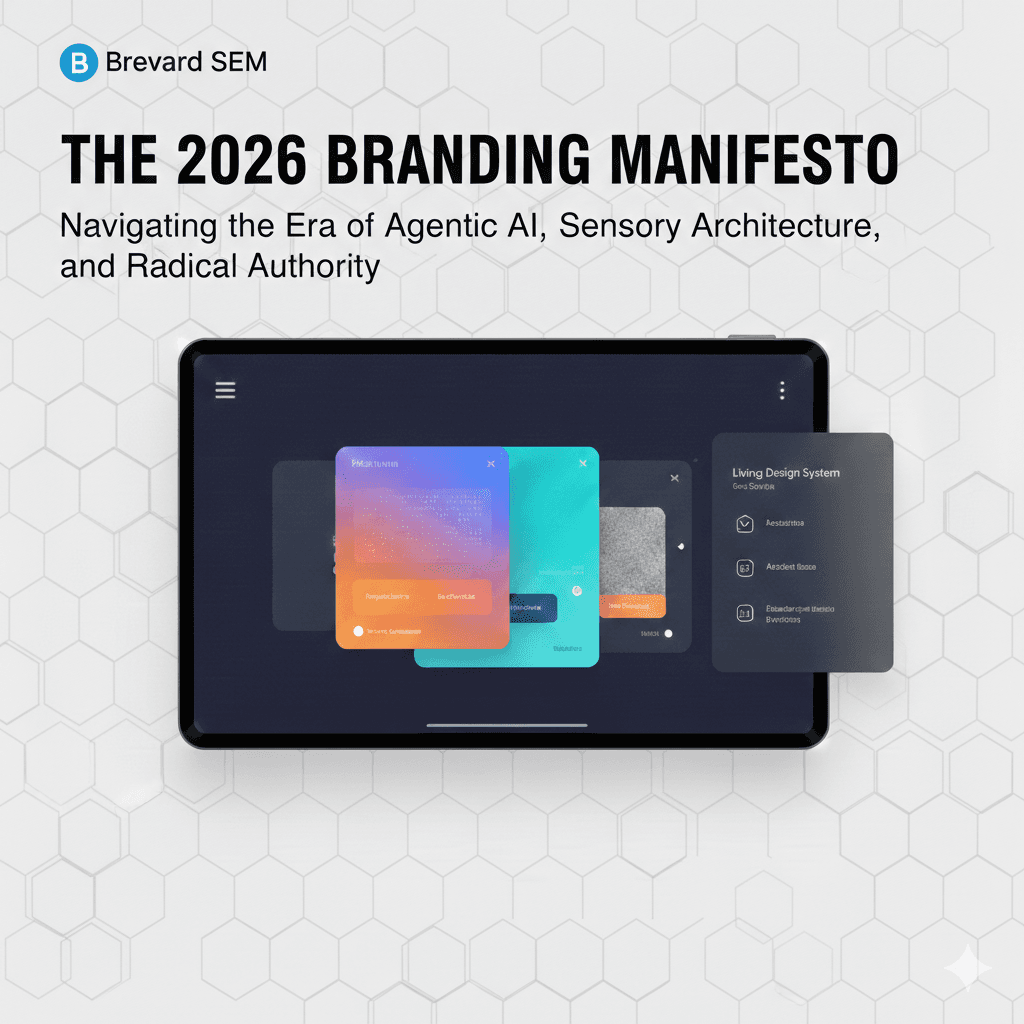
In the mid-2020s, the “digital transformation” was a buzzword. By 2026, it is a survival requirement. For mid-to-large-scale enterprises across the United States, the traditional marketing playbook—buying attention through high-ad spend and rigid brand guidelines—has been rendered obsolete.
We are entering the era of Agentic AI, where software agents make purchasing decisions on behalf of humans. We are entering the era of Sensory Branding, where digital fatigue has driven a desperate craving for tactile, human-centric experiences. And most importantly, we are entering the era of Radical Authority, where trust is the only currency that isn’t being devalued by AI-generated noise.
At Brevard SEM, we partner with growth-minded organizations nationwide to bridge the gap between legacy branding and future-ready systems. This is the landscape of 2026.
The Agentic Shift: Branding for the “Machine Middleman”
For decades, brands optimized for the human eye. In 2026, you must optimize for the AI Agent. Whether it’s an enterprise procurement bot or a personal digital assistant, “Agentic AI” is now the gatekeeper between your brand and your customer.
From SEO to AEO (Answer Engine Optimization)
Search Engine Optimization has evolved into Answer Engine Optimization. When a Chief Procurement Officer asks their AI agent to “find the three most reliable logistics partners for cold-chain shipping in the Northeast,” the AI doesn’t browse a list of blue links. It scans for structured data, verified authority signals, and deep-funnel content that proves competence.
- Machine-Readable Authority: Enterprise brands must now prioritize “Schema-First” content strategies. Your brand’s expertise must be indexed in a way that AI can parse, synthesize, and recommend with high confidence.
- Zero-Click Commerce: The goal is no longer a website visit; it is a “Zero-Click” conversion where the AI agent confirms a transaction or schedules a demo based on your brand’s established digital trust.
The “Trust Graph” vs. The Sales Funnel
In the national B2B market, the traditional sales funnel has been replaced by the Trust Graph. AI agents calculate “reputation scores” by cross-referencing your whitepapers, your leadership’s LinkedIn presence, and third-party reviews. Mid-to-large businesses that neglect their broader digital ecosystem—beyond just their homepage—will find themselves invisible to the AI decision-makers of 2026.
Sensory Architecture: Design You Can Feel
After years of “flat design” and sterile SaaS aesthetics, 2026 marks a return to materiality. Large-scale brands are realizing that in a world of infinite digital replicas, the physical and sensory become premium.
Lived Sensations and Tactile Digitalism
Visual identity is no longer static. Enterprise brands are adopting Adaptive Visual Systems that respond to the environment.
- Hyper-Realistic Textures: Modern web design for 2026 utilizes “Glassmorphism 2.0” and hyper-realistic, waxy, or organic textures that create a sense of depth and physical presence on high-resolution screens.
- Audio Signatures: Sound is no longer an afterthought. Just as Intel has its chime, mid-market brands are developing “Sonic Identities” for their apps, videos, and even physical office spaces to build brand recall in a screen-fatigued world.
Spatial Branding in the Hybrid Workplace
For national firms, the office is no longer just a place to work—it is a brand activation. 2026 workplace trends lean into Character-Driven Design. We are seeing a move away from generic corporate branding toward “curated stories.” Large enterprises are using regional art, custom acoustic textiles, and “soft architecture” (curves and organic forms) to create spaces that employees actually want to inhabit.
Executive Branding: The New Front Door
In 2026, people do not trust logos; they trust leaders. Executive Branding has shifted from a “nice-to-have” for CEOs to a core revenue driver for the entire enterprise.
From Performance to Ownership
National brands are encouraging their subject matter experts to build Owned Communities. This isn’t about “influencing” in the 2022 sense; it’s about Intellectual Authority.
- Founder-Led Marketing: Data shows that founder-led content on platforms like LinkedIn generates up to 4x the engagement of corporate brand pages.
- Radical Transparency: Mid-large businesses are winning by showing the “messy middle”—the R&D failures, the strategic pivots, and the human decisions behind the quarterly reports.
The Rise of “Calm Expertise”
In a noisy market, “loud” is common. “Calm” is a differentiator. In 2026, the most successful executive brands focus on Clarity > Volume. They don’t post every day; they post when they have a unique perspective that simplifies a complex industry problem.
Local Roots, Global Reach: The Brevard Advantage
While Brevard SEM operates on a national stage, our foundation in Brevard County, Florida, gives us a unique perspective on the intersection of “High-Tech” and “Human-Touch.”
Brevard is the home of the Space Coast—a region defined by engineering precision and frontier-pushing innovation. This local DNA informs how we handle our national enterprise clients. We understand that whether you are a defense contractor in Melbourne or a nationwide FinTech firm, your brand needs two things:
- Technical Excellence: The “engineering” of your SEO and AI-readiness.
- Community Connection: The “humanity” of your brand story.
Our work in the Brevard market allows us to test “Local-to-Global” strategies, ensuring that even the largest corporations maintain the “hometown trust” that is so easily lost at scale.
Design Ops and Brand Governance
For large organizations, the challenge isn’t creating a brand—it’s maintaining it across thousands of touchpoints. In 2026, Design Ops is the backbone of brand integrity.
The Blueprint for AI-Ready Systems
We help our clients transition from “Static Brand Books” to Living Design Systems.
- Component Libraries: Using tools like Figma and specialized AI-asset generators, we build libraries that allow your marketing teams to scale content without diluting the brand’s visual DNA.
- AI Governance: As more companies use AI to generate marketing copy and imagery, having a “Human-in-the-Loop” governance policy is essential. We establish the guardrails that ensure your AI-enhanced content still sounds like you.
Inclusive & Accessible by Default
By 2026, accessibility is no longer a compliance checkbox; it is a brand value. Enterprise buyers and public-sector organizations prioritize brands that demonstrate a commitment to Inclusive Design. This means high-contrast palettes, screen-reader-optimized layouts, and motion-sensitive UI that respects the neurodiversity of your entire audience.
So… Why Brevard SEM?
The trends of 2026—Agentic AI, sensory design, and executive authority—all point toward a single truth: Authenticity is the only moat left.
At Brevard SEM, we don’t just follow these trends; we build the systems that allow mid-to-large-scale businesses to lead them. We combine the technical rigor required for the AI era with the creative soul required for the human era.
Your Next Step for 2026
The window for “wait and see” has closed. Organizations that fail to optimize for AI agents and human sensations in 2026 will find themselves irrelevant by 2027.
Would you like us to perform a Comprehensive Brand & AI-Readiness Audit for your organization? Let’s ensure your enterprise isn’t just visible, but authoritative in the new era of branding and design.